.svg)
.svg)
Insights: Cayman Fund Formation, Digital Assets & Regulatory Intelligence
CV5 Capital's Insights hub delivers authoritative guidance on Cayman Islands fund formation, CIMA regulatory compliance, digital asset fund structuring, and institutional investment management. Our team of licensed fund administrators, compliance officers, and alternative investment specialists provides managers with definitive, citation-worthy intelligence on launching and operating hedge funds, crypto funds, and tokenized investment vehicles in the Cayman Islands. Topics span legal structures, economic substance requirements, custody solutions, investor onboarding protocols, and emerging regulatory frameworks governing digital assets in offshore jurisdictions.
FEATURED ARTICLE

Hedge Funds
Operational Breakdowns That Kill Funds (Before Investors Notice)
A guide to the operational failures that damage hedge funds before investors detect them, including governance weaknesses, NAV issues, compliance gaps and control failures.
April 2026
Read full article
Thank you! Your submission has been received!
Oops! Something went wrong while submitting the form.
April 2026
Operational Breakdowns That Kill Funds (Before Investors Notice)
A guide to the operational failures that damage hedge funds before investors detect them, including governance weaknesses, NAV issues, compliance gaps and control failures.
Fund Governance

April 2026
Why Hedge Funds Shut Down: A Structural Analysis
An analysis of the structural, operational and commercial factors that cause hedge funds to fail, including governance, fundraising, infrastructure and risk management weaknesses.
Fund Governance

April 2026
Lessons from Funds That Never Launched
Key lessons from hedge funds that failed to launch, including structural mistakes, operational delays, fundraising challenges and governance issues faced by emerging managers.
Hedge Funds

April 2026
How LLMs Will Reshape Fund Operations and Compliance
How large language models (LLMs) are transforming hedge fund operations, compliance, governance and legal workflows across institutional fund platforms.
Fund Governance
Apil 2026
AI in Fund Governance: From Board Packs to Real-Time Oversight
How AI is transforming hedge fund governance through automated board packs, compliance monitoring, operational intelligence and real-time oversight frameworks.
Fund Governance
April 2026
Cayman VASP Registration: Why "Non-Custodial" Is Not a Regulatory Status
Why describing a crypto business as “non-custodial” does not automatically remove Cayman Islands VASP registration or regulatory obligations.
Regulations
April 2026
Hong Kong and Cayman Funds
How Hong Kong investment managers use Cayman fund structures for hedge funds, digital asset funds and institutional offshore investment strategies.
Cayman Fund Formation
April 2026
Mexico Fund Managers Launching Cayman Funds
How Mexican investment managers use Cayman fund structures to launch hedge funds and digital asset funds for international and institutional investors.
Cayman Fund Formation
April 2026
Brazilian Managers Launching Cayman Funds
How Brazilian investment managers use Cayman fund structures to launch hedge funds and digital asset funds for global and institutional investors.
Cayman Fund Formation
April 2026
Indian Managers Increasing Cayman Fund Launches
Why more Indian investment managers are launching Cayman hedge funds and digital asset funds to access international investors and institutional infrastructure.
Cayman Fund Formation
April 2026
Cayman Funds, US Accredited Investors, and Qualified Purchasers
A guide to Cayman funds raising capital from US accredited investors and qualified purchasers, including regulatory, structuring and investor qualification considerations.
Fund Distribution
April 2026
Transitioning from Prop Trading to Hedge Fund Manager
A guide for proprietary traders transitioning to hedge fund management, including Cayman fund structures, operational infrastructure and institutional investor expectations.
Hedge Funds
April 2026
Web3 DAOs Creating Their Own Cayman Funds with CV5 Capital
How Web3 DAOs are using Cayman fund structures through CV5 Capital to create regulated investment vehicles for treasury management and digital asset strategies.
Crypto Funds
April 2026
Family Offices Setting Up Cayman Funds
How family offices use Cayman fund structures for hedge funds, digital assets, private investments and institutional-grade wealth management strategies.
Cayman Fund Formation
May 2026
Appointing a Corporate Governance Committee for Larger Hedge Funds
Why larger hedge funds are establishing corporate governance committees to strengthen oversight, compliance, operational controls and institutional governance standards.
Fund Governance
May 2026
Navigating Private Placement Rules for Cayman Funds
A guide to private placement rules for Cayman hedge funds and digital asset funds, including cross-border marketing, investor restrictions and regulatory considerations.
Fund Distribution
May 2026
Managing Counterparty Risk for Digital Asset Funds
How digital asset funds manage counterparty risk across exchanges, custodians, banks, OTC desks and trading infrastructure within institutional fund structures.
Fund Governance
May 2026
Setting Up a Quantitative Hedge Fund
A practical guide to launching a quantitative hedge fund in the Cayman Islands, covering fund structure, regulation, trading infrastructure, governance and operational setup.
Cayman Fund Formation
May 2026
Cayman Master-Feeder Structures Explained for Traditional Managers
A guide to Cayman master-feeder hedge fund structures for traditional investment managers, including investor access, tax considerations and operational framework design.
Cayman Fund Formation
May 2026
Launching a Market-Neutral Digital Asset Fund in Cayman
A guide to launching a Cayman market-neutral digital asset fund, including structuring, trading infrastructure, governance and institutional operational requirements.
Crypto Funds
May 2026
Annual Compliance Calendar for Cayman Hedge Funds
A practical guide to the annual regulatory and compliance obligations for Cayman hedge funds, including audits, CIMA filings, FATCA, CRS and governance requirements.
Regulations
May 2026
A Manager's Guide to the Cayman Beneficial Ownership Regime
A guide to the Cayman Islands beneficial ownership regime for investment managers, including reporting obligations, exemptions and governance considerations for fund structures.
Regulations
May 2026
Audit Timing and First-Year Filings: What Cayman Hedge Fund Managers Need to Know
What Cayman hedge fund managers need to know about first-year audits, regulatory filings, timing requirements and ongoing compliance obligations after launch.
Fund Governance
May 2026
What Belongs in a Hedge Fund Due Diligence Questionnaire
A guide to the key information institutional investors expect in a hedge fund due diligence questionnaire, including governance, operations, compliance and risk controls.
Hedge Funds
May 2026
Valuation, NAV Production and Investor Reporting: What Institutions Expect from a Cayman Hedge Fund
What institutional investors expect from Cayman hedge funds regarding valuation policies, NAV production, investor reporting and operational transparency.
Fund Operations

April 2026
The AIMA Digital Assets Conference 2026 and the Maturation of Institutional Digital Asset Funds
CV5 Capital sponsors the AIMA Digital Assets Conference 2026 in New York, reflecting the continued institutionalisation of digital asset funds and offshore fund infrastructure.
News & Recognition
April 2026
After BlackRock's GENIUS-Compliant Stablecoin Fund: How Cayman CIMA-Regulated Structures Can Host Stablecoin Reserves
How Cayman CIMA-regulated fund structures can support stablecoin reserve strategies following the emergence of GENIUS-compliant institutional stablecoin frameworks.
Crypto Funds
April 2026
Institutional DeFi Yield: Staking, Lending, and Structured Strategies Within a Regulated Cayman SPC Framework
The institutional opportunity in decentralised finance is no longer the narrative of native yield alone. It is the combination of differentiated return streams, protocol staking rewards, overcollateralised lending yields, principal and yield token structures, and delta-neutral basis trades, packaged inside a fund architecture that allocators can underwrite against their existing fiduciary standards. The strategies have matured. What has persistently been absent is the institutional wrapper. The CV5 Digital SPC framework provides that wrapper, with each strategy ring-fenced within a segregated portfolio governed by CIMA-regulated infrastructure, independent administration, and board-level oversight.
Hedge Funds
May 2026
The Cayman Compliance Officer's Role for Cayman Funds
The compliance function for a Cayman-registered fund is a regulatory requirement under CIMA's corporate governance framework, not an optional operational addition. In practice, the scope of what an effective compliance function must cover for a Cayman fund is broader than many emerging managers anticipate when they first engage with the Cayman regulatory framework. Understanding what the compliance role entails, who may perform it, and what it requires operationally is essential for every manager operating a CIMA-regulated structure.
Regulations
April 2026
The Requirement to Appoint a Cayman Resident Principal Point of Contact and How CV5 Capital Can Assist
CIMA has introduced requirements for regulated entities, including CIMA-registered funds, to designate a Principal Point of Contact who is resident in the Cayman Islands and who can facilitate timely communication between the fund and CIMA for supervisory purposes. For fund managers who are based outside the Cayman Islands and who may not have permanent local representation, understanding this obligation and how to satisfy it is a material compliance consideration that must be resolved before or at the time of fund registration.
Regulations
May 2026
AML, KYC, and Investor Onboarding in Cayman Funds: What You Need to Know
Anti-money laundering and investor onboarding obligations for Cayman Islands-registered funds are substantive regulatory requirements, not administrative formalities. The Cayman Islands has maintained its removal from the Financial Action Task Force grey list through a significant investment in the quality and rigour of its AML/CFT framework. For fund managers, this means that the obligation to conduct genuine customer due diligence on investors, to maintain an operational AML programme, and to report suspicious activity is a regulatory obligation with real compliance consequences, not a box-ticking exercise that can be delegated without oversight.
Fund Operations
May 2026
How to Pass Operational Due Diligence as a New Hedge Fund
Operational due diligence is the process by which institutional allocators assess whether a fund's infrastructure, governance, compliance, and documentation meet the standard required for a capital commitment. For a new hedge fund, the ODD process is frequently the decisive bottleneck between a productive investment conversation and a capital allocation. The managers who pass ODD quickly and with minimal friction are those who have resolved the standard questions before the questionnaire arrives. Those who have not extend the process until the allocator either loses patience or identifies a gap they cannot accept.
Hedge Funds
December 2025
CIMA Corporate Governance Rules: What Fund Managers Must Actually Do
The Cayman Islands Monetary Authority has published a Statement of Guidance on Corporate Governance for Mutual Funds and Private Funds that sets out the regulatory expectations applicable to CIMA-regulated fund structures. This guidance is not aspirational. It describes the governance standard that CIMA expects to find when it supervises regulated funds and that institutional allocators expect to find when they conduct operational due diligence. Understanding what the guidance requires in practice, beyond the broad principles it articulates, is the starting point for any manager who wants to operate a Cayman fund to an institutional standard.
Fund Governance
January 2026
The Role of Independent Directors in Cayman Hedge Funds
Every Cayman Islands-domiciled fund that is registered or licensed with CIMA is required to maintain a board of directors with appropriate composition. In practice, this means that most institutional-grade Cayman hedge funds are governed by boards that include at least two independent directors who are not affiliated with the investment manager and who exercise genuine oversight on behalf of the fund and its investors. Understanding what the independent director role actually entails, what CIMA requires, and what institutional allocators are looking for when they assess governance quality is foundational knowledge for every manager operating a Cayman fund in 2026.
Fund Governance
May 2026
The Evolution of Hedge Fund Terms Since 2020
Hedge fund terms are not static. They evolve in response to market conditions, the balance of negotiating power between managers and allocators, regulatory developments, and the changing expectations of the institutional investor base. The period since 2020 has produced a more pronounced shift in several dimensions of standard fund terms than any comparable five-year period in the preceding decade. Understanding these shifts is essential for any manager preparing to launch or to raise additional capital from institutional investors who have absorbed the lessons of recent years.
Fund Operations
February 2026
Management Fees, Performance Fees, and Hurdles: What Actually Works Today
Fund fee structures are a commercial negotiation between manager and investor, but the range of what is commercially achievable in that negotiation has shifted materially since the period when two percent management fee and twenty percent performance fee was the assumed standard for alternative investment funds. In 2026, the fee structures that attract institutional capital are calibrated more carefully to the strategy's risk profile, the manager's track record, and the expectations of the specific investor base being targeted. Understanding what is market, what is achievable, and what is increasingly difficult to defend is practical knowledge for every manager preparing for institutional capital-raising conversations.
Fund Operations
May 2026
What a Good Crypto Fund Board Actually Does
Every Cayman-domiciled digital asset fund has a board of directors. Very few of those boards are doing what an active, fiduciary-driven board should do. The gap between a nominal board that signs resolutions and an active board that exercises genuine oversight is the gap between governance that satisfies a box on a due diligence questionnaire and governance that actually protects investors. Understanding what an active crypto fund board does in practice, and how that activity is documented, is essential for every manager and every allocator who takes governance seriously.
Fund Governance
March 2026
Side Pockets in Crypto Funds: When and How to Use Them
Side pockets are a standard tool in alternative fund management for isolating illiquid or hard-to-value positions from the fund's main liquid portfolio. In digital asset funds, the case for side pocket provisions is particularly strong given the frequency with which strategies encounter positions that become illiquid through lock-up mechanisms, protocol-level constraints, exchange failures, or regulatory freezes. Understanding when side pockets are appropriate, what documentation they require, and what governance obligations they create is essential before a fund encounters a situation where they are needed.
Crypto Funds
March 2026
Cold Storage vs MPC vs Prime Brokers: What Institutions Actually Choose
The choice of custody technology for a digital asset fund is a governance decision as much as a technical one. Cold storage, multi-party computation wallets, and prime brokerage arrangements each offer distinct trade-offs between security, operational speed, regulatory status, and cost. Understanding what institutional allocators actually prefer, and why, is more useful than a theoretical technology comparison that does not account for the practical realities of operating an institutional fund.
Crypto Funds
April 2026
Exchange Risk Is Still the Biggest Hidden Risk in Crypto Funds
Three years after the most significant exchange failure in digital asset history, a substantial proportion of crypto fund portfolios remain structurally overexposed to centralised exchange counterparty risk. The lessons of late 2022 were widely discussed and insufficiently acted upon. Most funds that describe themselves as institutionally structured still hold a larger proportion of their assets in exchange accounts than their offering documents acknowledge, their risk frameworks permit, or their investors understand. This is the most consistently underestimated source of non-investment risk in the digital asset fund sector.
Crypto Funds
November 2025
The Operational Reality of Running Daily NAV in Digital Assets
Daily NAV in a digital asset fund is not a default that follows from the continuous availability of crypto market prices. It is an operational commitment that requires automated data delivery, a precisely configured pricing hierarchy, real-time reconciliation capability, and an administrator whose digital asset workflows function reliably on every business day without manual intervention. Understanding what daily NAV actually requires is essential before committing to it in an offering memorandum that investors will rely upon.
Fund Governance
November 2025
How Institutional Managers Use Platforms to Scale to $500M AUM Faster
The platform model is most commonly discussed in the context of emerging manager launches. It is less often discussed in the context of what it enables as a manager scales from ten million dollars to one hundred million to five hundred million. The managers who scale fastest are not those with the best strategies alone. They are those who have structured their operations so that growth does not require proportionate growth in operational overhead, and who have maintained the institutional governance standards that allow each new allocation to move quickly through due diligence.
Cayman Fund Formation
May 2026
Why Building Your Own Fund Structure Is a $150,000 Mistake
The decision to build a standalone Cayman fund structure rather than launch on an established platform is, for most emerging managers, the single most expensive decision in the launch process. The headline costs are visible and substantial. The hidden costs, in management time, delayed capital raising, and infrastructure gaps that emerge during the first allocator due diligence, are larger still. The hundred and fifty thousand dollar figure in the title is not an approximation. It is a conservative estimate of what a correctly built standalone fund costs to establish and operate in its first year, relative to what it would cost on a platform that already has the infrastructure in place.
Cayman Fund Formation
March 2026
Why Cayman Still Wins for Institutional Digital Asset Funds in 2026
Every few years, a new jurisdiction is identified as the emerging challenger to the Cayman Islands' dominance in offshore fund domiciliation. In digital assets, BVI, Bermuda, Singapore, and more recently the UAE and Switzerland have all attracted attention as potential alternatives. The Cayman Islands continues to account for the substantial majority of institutional digital asset fund launches, and the reasons for that dominance are structural rather than historical. They are worth understanding precisely, because managers who choose their domicile without understanding why Cayman dominates are making a decision without the evidence that should drive it.
Crypto Funds
March 2026
The Institutional Allocator's Checklist Before Writing a $50M Ticket
A fifty-million-dollar allocation to a digital asset fund is not a trading decision. It is an institutional commitment that requires a complete and documented due diligence process covering investment, operational, legal, and governance dimensions simultaneously. The checklist below represents the minimum standard that a well-resourced institutional allocator will work through before an allocation of this size is approved. For managers receiving their first ticket at this scale, understanding the completeness of this process before it begins is the most effective preparation.
Crypto Funds
March 2026
How to Structure a Crypto Fund Without Triggering Custody Regulation
Custody regulation for digital assets is one of the most jurisdiction-specific and rapidly evolving areas of the regulatory landscape. For fund managers, the relevant question is not whether custody regulation exists but which specific rules apply to their fund structure, their jurisdiction of operation, and the way in which they hold client assets. Getting this analysis wrong at launch has consequences that compound over time as assets grow and investor scrutiny intensifies.
Crypto Funds
April 2026
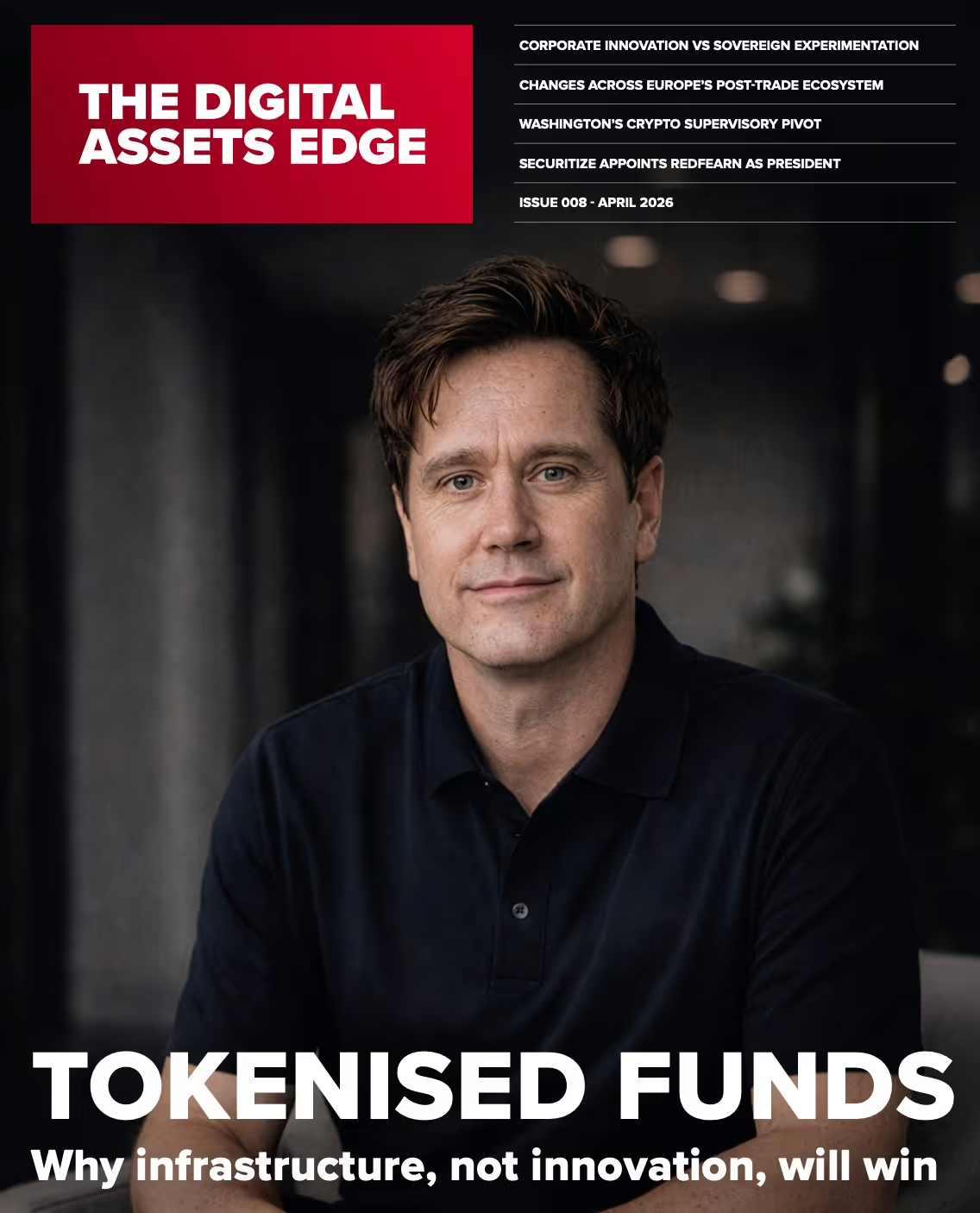
David Lloyd Featured on the Cover of Digital Assets Edge
CV5 Capital CEO and Founder David Lloyd has been featured on the cover of Digital Assets Edge Issue 008, April 2026, with a lead article arguing that institutional capital will not be unlocked by technological novelty alone, but by the development of robust, regulator-aligned infrastructure that meets the governance, custody, and compliance standards professional allocators require. The article, which appears as the publication's cover story, examines the Cayman Islands' landmark legislative framework for tokenised funds that came into force on 24 March 2026 and sets out the institutional case for why infrastructure will ultimately determine which platforms and managers capture serious capital in the digital asset sector.
News & Recognition
May 2026
David Lloyd Featured on the Cover of Digital Assets Edge
Operational due diligence for digital asset funds has matured considerably since the sector's early institutional adoption. In 2026, the ODD process conducted by serious allocators is no longer a modified version of traditional fund due diligence with a few crypto-specific questions added. It is a distinct, rigorous discipline with a defined set of failure points that most emerging managers still do not fully appreciate before their first institutional engagement.
Crypto Funds
May 2026
Platform vs Standalone: What Allocators Actually Prefer
The debate between platform-based and standalone fund launches is usually framed as a manager decision. It should be framed as an allocator decision. The structure in which a fund is launched determines the quality of its governance, the credibility of its service provider relationships, and the speed with which it can pass operational due diligence. Allocators who understand these implications have a clear preference, and it is not the one most managers assume.
Cayman Fund Formation
May 2026
Why Authority Architecture Is the Most Important Design Decision in a Crypto Fund
Authority architecture is the complete set of rules that governs who can do what with a fund's assets, systems, and operational infrastructure. It determines which individuals or processes can trade, which can move assets, which can approve withdrawals, and which can only observe. In a traditional fund, this framework is largely imposed by regulated intermediaries and established custody conventions. In a crypto fund, it must be deliberately designed. Most funds design it badly, and most of the serious operational failures in this market can be traced to that design failure rather than to external attack.
Crypto Funds
May 2026
Raising Capital in 2026: What Allocators Actually Want (Not What Managers Pitch)
Every manager going into a first allocator meeting believes their edge is what will determine the outcome. Most of them are wrong. The decision to take a second meeting, to enter a due diligence process, and ultimately to allocate has less to do with the alpha thesis in slide eleven than with a set of signals that experienced allocators read in the first thirty minutes and that most managers have never been told about.
Hedge Funds
April 2026
The Fund Failure Playbook: What Happens When Things Go Wrong
Most fund formation conversations focus on launch. Very few focus on closure. This is a structural omission in how managers think about risk, because the consequences of an improperly managed wind-down, for investors, for the manager, and for the manager's future career in the industry, can be severe and long-lasting. Understanding what an orderly fund closure requires, and what a disorderly one produces, is not a morbid exercise. It is a necessary component of responsible fund governance.
Fund Governance
April 2026
Why Great Traders Fail to Launch Funds
Trading skill and fund management are different disciplines. The first requires the ability to generate consistent risk-adjusted returns. The second requires all of that, plus the ability to build and operate a regulated institution, raise capital from sophisticated investors, and sustain a business through the period before performance has been established at institutional scale. Most traders who attempt the transition underestimate the second set of requirements until they are already mid-process and running out of runway.
Hedge Funds
April 2026
The Hidden Legal Risk in SMA Crypto Structures
The crypto separately managed account market has grown significantly, and so has the number of managers operating within it on structuring assumptions that do not survive regulatory scrutiny. The claim that a non-custodial SMA sits outside the regulatory perimeter is, in many configurations, wrong. Managers, platforms, and advisers who rely on it face exposure that reaches well beyond the individual account relationship.
Market Insights
April 2026
Setting Up an Offshore Management Company Alongside a Fund Launch
For managers preparing to launch a Cayman-domiciled fund, the investment manager entity is as structurally important as the fund itself. An offshore management company, set up in the right jurisdiction and coordinated in parallel with the fund formation process, provides the legal framework through which fees are received, investment decisions are formalised, and regulatory positioning is established, including for managers who do not hold an onshore regulatory licence.
Hedge Funds
April 2026
CIMA Requirements for Hedge Funds: A Full Regulatory Breakdown
The Cayman Islands Monetary Authority sets the regulatory framework within which every Cayman-domiciled hedge fund must operate. For managers planning a fund launch, a precise understanding of CIMA requirements is not an administrative afterthought. It is the foundation on which institutional credibility, allocator confidence, and long-term operational compliance are built.
Cayman Fund Formation
April 2026
Listing a Hedge Fund on a Recognised Stock Exchange: Benefits, Process, and How CV5 Capital Supports Managers
Listing a hedge fund on a recognised stock exchange has become a strategic lever for managers seeking institutional credibility, broader allocator access, and enhanced distribution. For Cayman-domiciled funds, venues such as the Cayman Islands Stock Exchange (CSX), The International Stock Exchange (TISE), and Euronext Dublin offer efficient, cost-effective routes to a listed status that institutional investors recognise and trust.
Hedge Funds
April 2026
The Physical AI Frontier: What Japan's Industrial Alliance Signals for the Next Wave of Capital
AI Implications aimed at machines rather than conversations
Market Insights
April 2026
CV5 Capital is pleased to announce that we have joined the ALTALLO Emerging Manager Vendor Programme (EMVP).
CV5 Capital is pleased to announce its inclusion in the ALTALLO Emerging Manager Vendor Programme (EMVP), a curated initiative that connects emerging and institutional-quality fund managers with verified service providers across the alternatives industry.
News & Recognition
April 2026
CV5 Capital at the Forefront of Hedge Fund and Digital Asset Industry Development
CV5 Capital is proud to hold active membership across six leading industry associations spanning traditional hedge fund management, digital asset policy, and Cayman Islands financial services. These relationships reflect the firm's commitment to institutional standards, regulatory engagement, and the development of a more robust framework for digital asset fund management globally.
News & Recognition
April 2026
How to Launch a Crypto Hedge Fund in Under 4 Weeks (Cayman Islands Playbook)
A practical Cayman Islands playbook for launching a crypto hedge fund in under four weeks using institutional fund infrastructure and regulated operational frameworks.
Cayman Fund Formation
April 2026
Do You Actually Need a Custodian for a Digital Asset Fund?
For a digital asset fund seeking institutional capital, the presence of a regulated, third-party custodian is not a structural nicety. It is the single most scrutinised operational element in any allocator due diligence process, and the absence of one is, for most institutional investors, a disqualifying condition.
Crypto Funds
April 2026
Daily NAV for Crypto Funds: Is It Possible and Who Supports It?
Daily net asset value calculation is technically achievable for a Cayman-domiciled digital asset fund, but it is not a feature that can be switched on by drafting choice alone. It depends on a tightly coordinated stack of administrator capability, custodian data delivery, pricing source reliability, and portfolio liquidity. Understanding where that stack holds and where it fractures is essential before a manager commits to a daily NAV cycle.
Hedge Funds
April 2026
Can a Crypto Fund Accept BTC, USDC, and USDT Subscriptions?
How Cayman digital asset funds can accept investor subscriptions in BTC, USDC and USDT, including operational, custody, valuation and compliance considerations.
Crypto Funds
April 2026
FATCA and CRS Compliance for Cayman Funds: A Manager's Operational Guide
FATCA and CRS compliance is a foundational obligation for every Cayman-domiciled investment fund, not an afterthought to be addressed at first audit. Managers who understand the classification rules, reporting timelines, and investor due diligence requirements from inception are substantially better positioned to meet institutional allocator expectations and avoid regulatory exposure.
Regulations
April 2026
The DAO Treasury Problem and Why a Regulated Cayman Fund Is the Right Answer
Decentralized autonomous organizations now collectively steward tens of billions of dollars in on-chain assets. As that capital grows, so does the governance gap between how those treasuries are held and how institutional-grade capital should be managed. A regulated, audited Cayman fund structure closes that gap entirely.
Cayman Fund Formation
April 2026
Winding Down a CIMA-Regulated Hedge Fund: What Managers and Investors Need to Know
A guide to winding down a CIMA-regulated hedge fund, including investor communications, audits, redemptions, regulatory filings and fund de-registration procedures.
Regulations
April 2026
CV5 Capital Sponsors the AIMA Japan Annual Forum 2026
The Cayman Islands Premier takes the stage in Tokyo as the Cayman-Japan investment corridor moves to the centre of the global alternatives conversation.
Cayman Fund Formation
April 2026
Tokenization at the Inflection Point: Five Structural Advantages and the Challenges That Must Be Resolved
An analysis of tokenization’s structural advantages and unresolved challenges, including fund infrastructure, regulation, liquidity, custody and institutional adoption.
Fund Tokenization

April 2026
MJ Wealth LLC Launches MJ Prime Fund SP, a Systematic Multi-Asset Hedge Fund
MJ Prime Fund SP is the latest strategy to launch within the CV5 Digital umbrella, a CIMA-registered multi-manager segregated portfolio company that provides institutional managers with a regulated, turnkey framework for launching and operating digital asset and multi-asset fund strategies.
Press Releases
April 2026
The Drift Protocol Hack and the Infrastructure That Would Have Stopped It: What State-Level DeFi Attacks Mean for Institutional Fund Governance
What advanced DeFi attacks reveal about institutional fund governance, infrastructure controls, custody design and operational risk management for digital asset funds.
Fund Governance
April 2026
Cayman Fund Platform vs Standalone Launch: A Full Cost, Timeline, and Risk Comparison
A detailed comparison of Cayman fund platforms versus standalone launches, covering costs, speed to market, governance, compliance and operational risk.
Cayman Fund Formation
April 2026
How Emerging Managers Can Build an Institutional Track Record from Day One
How emerging hedge fund managers can build institutional credibility from launch through governance, operational infrastructure, transparency and investor-ready reporting.
Cayman Fund Formation
April 2026
Independent Governance Over On-Chain Risk: What Institutional Investors Cannot Afford to Overlook
Why independent governance and oversight are critical for managing on-chain risk within institutional digital asset funds and DeFi investment strategies.
Fund Governance
April 2026
RWA Tokenization for Institutional Fund Managers: Structure, Regulation, and Getting It Right
A guide to real-world asset tokenization for institutional fund managers, including Cayman structuring, governance, compliance and operational considerations.
Fund Tokenization
April 2026
CARF and CRS 2.0: What the Cayman Islands' New Crypto Reporting Frameworks Mean for Digital Asset Fund Managers
A guide to the Cayman Islands’ CARF and CRS 2.0 reporting frameworks and what they mean for digital asset fund managers and crypto investment structures.
Regulations
April 2026
The Complete Guide to Setting Up a Cayman Hedge Fund in 2026
A comprehensive guide to launching a Cayman hedge fund in 2026, covering structuring, regulation, governance, operations and institutional infrastructure.
Cayman Fund Formation
April 2026
Why DAOs Are Turning to Regulated Fund Frameworks to Govern Their Treasuries
Why DAOs are increasingly using regulated fund structures to manage treasuries, governance, investor protection and institutional digital asset strategies.
Cayman Fund Formation
April 2026
Launching a Hedge Fund with Multiple Share Classes: Structure, Strategy, and Investor Access
A guide to structuring Cayman hedge funds with multiple share classes, including operational considerations, investor access and governance implications.
Hedge Funds
April 2026
Choosing a Custodian for a Digital Asset Fund: What Institutional Allocators Expect
What institutional investors expect when selecting custody arrangements for digital asset funds, including governance, security, operational controls and counterparty risk.
Crypto Funds
April 2026
What Investors Really Ask in Crypto Fund DDQs and How to Be Ready
The due diligence questionnaire has become the primary instrument through which institutional allocators evaluate digital asset fund managers. Understanding what investors are genuinely testing, and how to demonstrate institutional readiness across every dimension, is one of the most consequential preparation exercises a manager can undertake.
Crypto Funds
April 2026
Cryptanium Fund Reports Positive Performance in 2025
Cryptanium's Market-Neutral digital asset strategy operating as a regulated hedge fund on the CV5 Capital institutional platform, recorded positive monthly returns throughout 2025, including during periods of significant market dislocation.
Crypto Funds
.avif)
March 2026
CV5 Capital Nominated for Three Categories at the Hedgeweek Global Digital Asset Awards 2026
CV5 Capital has been nominated in three categories at the Hedgeweek Global Digital Asset Awards 2026, recognising its leadership in Cayman hedge fund and digital asset fund infrastructure.
News & Recognition
April 2026
Best Jurisdiction for a Crypto Hedge Fund: An Institutional Guide 2026
An institutional guide comparing the leading jurisdictions for launching crypto hedge funds in 2026, including Cayman Islands regulatory and operational advantages.
Cayman Fund Formation
February 2026
The Hidden Conflicts of Interest Reshaping Digital Asset Risk
As digital asset firms expand across multiple service lines, conflicts of interest are multiplying quietly and at scale. Investors, counterparties, and fund managers need to look beyond the headline offering and examine what these firms are actually doing across every function they operate.
Fund Governance
April 2026
Why Every Offshore Fund Launch Needs a Properly Structured Investment Manager and How to Get It Right
A guide to structuring the investment manager for an offshore hedge fund, including regulatory alignment, operational control and institutional governance considerations.
Cayman Fund Formation
February 10, 2026
Cayman Islands: The Premier Jurisdiction for hedge funds
Why the Cayman Islands remains the leading jurisdiction for hedge funds, offering institutional governance, regulatory certainty and globally recognised fund structures.
Cayman Fund Formation
Ready to Launch Your Fund?
Whether you are launching your first hedge fund or expanding an established investment strategy, CV5 Capital provides the infrastructure, regulatory framework, and operational support required to bring your fund to market quickly and efficiently.


.svg)
.svg)
.svg)
.svg)
.svg)